
Kingborough Council is commencing targeted investigations in December to better understand how stormwater discharges affect water quality at the southern end of Blackmans Bay Beach.
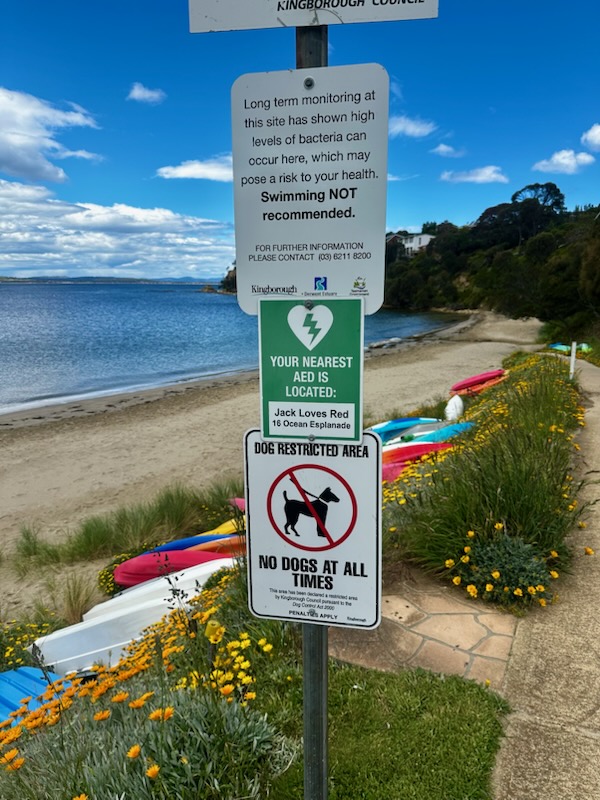
Kingborough Acting Mayor Clare Glade-Wright said the southern end of the beach was recently downgraded to Poor in the Derwent Estuary Program’s 2024 Recreational Water Quality Report.
“Swimming is only not advised at the southern end, we can confirm the rest of Blackmans Bay Beach remains safe for swimming,” Cr Glade-Wright said.
“Over the past five years, we’ve been working hard to understand how contaminants enter the stormwater network.
“While we don’t yet know the exact cause of the poor water quality at the southern end, an external report commissioned by Council suggests the number of stormwater discharge points at the southern end of the beach, the large residential catchment and ageing infrastructure were key contributors.
“Long term monitoring has confirmed the presence of enterococci bacteria (an indicator of contamination) in the water at times at levels above the recommended State and National guidelines.
“We know there are four stormwater outfalls in the area that carry runoff from around 3,000 properties and the road network in Blackmans Bay.
“Council has engaged a specialist consultant to design and undertake a targeted investigation to help pinpoint the source of contamination and how it disperses in the bay.
“The consultants have recommended approaches to deepen our understanding of how the stormwater system inputs impact the bay,” Cr Glade-Wright said.
“As part of this next stage, in early December, bright green dye (Fluorescein) will be added to water discharging from the beach stormwater outfalls.
“This dye is non-toxic, biodegradable, and produces an intense fluorescent green colour when dissolved in water.
“It’s a safe and effective tool for tracking water movement.
“The dye will be visible for about 24 hours and is safe for swimming and other primary contact activities.
“To monitor the dye’s movement over the tidal cycle, a drone and other tools will be used.”
During this time, community members may notice activities including:
- Increased water sampling
- Drone monitoring of how the dye spreads
- Deployment of a drogue (a floating device) to study water currents
This work will occur on weekdays between 9am and 5pm.
The findings from this investigation will be shared with the community via Council’s website in 2026 and will help guide future actions taken by Council to improve water quality at the beach.
More information including the report, is available here.